








 The North News
The North News
New Delhi, July 12
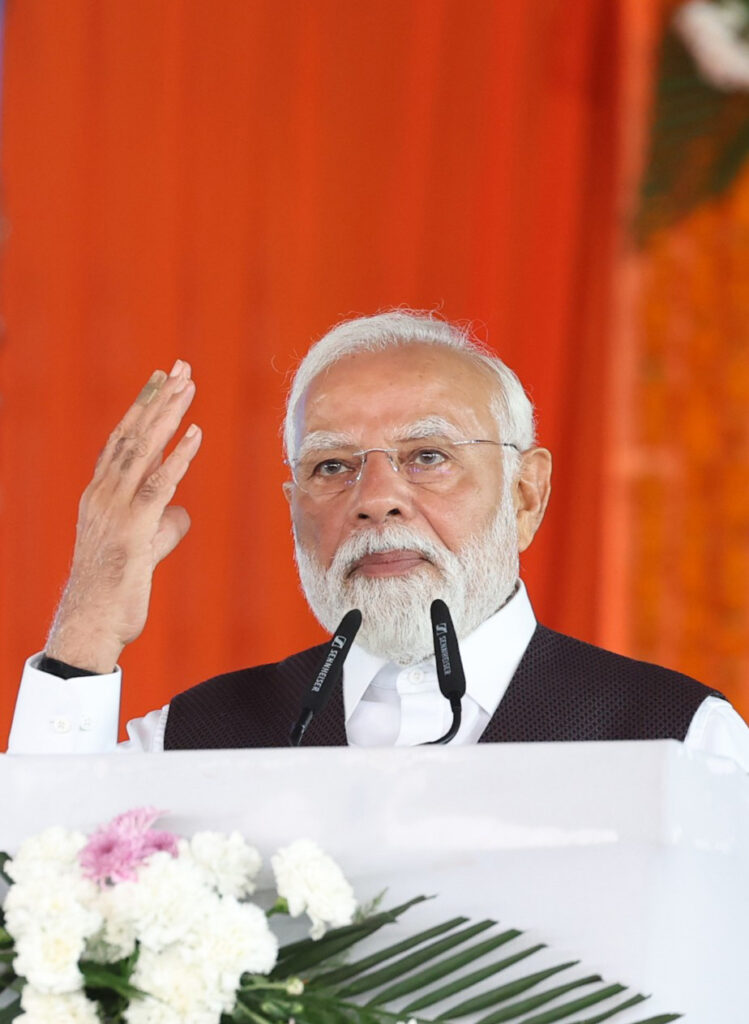
Prime Minister Narendra Modi on Saturday highlighted India’s dual strength of being the world’s largest democracy and having the largest youth population, describing them as the country’s most valuable assets. Speaking at an official event, Modi said that India’s demographic and democratic foundations gave it a unique opportunity to shape the future not just within its borders, but also on the global stage.
“Our youth power is the nation’s greatest capital,” the Prime Minister said. “This government is committed to turning that capital into a driver of long-term prosperity.” He reaffirmed the government’s focus on employment generation, innovation, and nation-building, stressing that India’s young population must be empowered to take the country to new heights.
Addressing a large group of newly recruited public servants during a virtual edition of the Rozgar Mela (Employment Fair), Modi distributed over 51,000 government appointment letters and described India’s youth as its “greatest capital”.
Framing the appointment of thousands of young individuals across government departments as a milestone moment, Modi congratulated the recruits and urged them to embrace their new roles with a spirit of public service. “Your job may be in different ministries, but the mission is the same – national service,” he said, invoking the ethos of “Citizen First” as a guiding principle.
The address came just two days after Modi returned from a five-nation tour, during which he signed agreements in defence, pharmaceuticals, digital technologies, energy, and rare earth minerals. He said these pacts were designed to create new opportunities for Indian youth, both within the country and abroad. “In every country I visited, the strength of India’s youth echoed strongly,” Modi said. “The agreements will bring far-reaching benefits to our young workforce.”
One of the key announcements was the Employment Linked Incentive Scheme, under which ₹15,000 would be paid to young people entering their first private-sector job. With a ₹1 lakh crore budget, the scheme aims to generate 3.5 crore new jobs across sectors.
The Prime Minister also emphasised the importance of innovation, research, and the rise of the startup culture in India, positioning them as central to the 21st-century employment landscape. He noted that the government is also investing in skill-building and expanding opportunities beyond traditional government jobs.
Modi highlighted India’s growing prominence in manufacturing, particularly in electronics, defence, and automobiles. He noted that the Production Linked Incentive (PLI) scheme has generated over 11 lakh jobs. “Today, electronics manufacturing in India is valued at ₹11 lakh crore, a fivefold increase over the past 11 years,” he said. Where India once had only a handful of mobile manufacturing units, it now boasts nearly 300, employing lakhs of people.
India’s rise in defence production was also praised, with the sector now surpassing ₹1.25 lakh crore in output. Modi added that India has become the largest locomotive producer in the world and that exports of locomotives, rail coaches, and metro coaches have seen a sharp rise. The automobile sector, too, has drawn $40 billion in foreign direct investment in five years, he said, spurring new factories, jobs, and record sales.
Modi took care to connect India’s welfare policies to job creation. Citing a recent report by the International Labour Organization (ILO), he said over 90 crore people have benefited from government schemes in the past decade. “These are not just welfare schemes—they are job creators,” he claimed.
He listed the employment created under PM Awas Yojana, which has already built 4 crore permanent houses with another 3 crore underway. He noted that the construction of 12 crore toilets under Swachh Bharat, 10 crore LPG connections under Ujjwala Yojana, and the scaling up of bottling plants and distribution centres have opened up lakhs of jobs.
Under the PM Surya Ghar Muft Bijli Yojana, households receive ₹75,000 subsidies for rooftop solar panel installations—initiatives which Modi said were creating work for engineers, solar technicians, and manufacturers.
He also praised the Namo Drone Didi scheme, which trains rural women to become drone pilots, and pointed to the success of the Lakhpati Didi initiative, aimed at helping 3 crore women become financially independent. So far, 1.5 crore women have crossed that threshold.
Modi highlighted how schemes like PM SVANidhi, which provides micro-loans to street vendors, and PM Vishwakarma, which supports traditional artisans and service providers, are bringing previously informal workers into the economic mainstream.
The Prime Minister asserted that 25 crore people have emerged from poverty in the last ten years—something he attributed to employment-driven welfare. “Without employment opportunities, such a transformation would not have been possible,” he said, adding that the World Bank and other global institutions have praised India’s progress.
He concluded by calling this decade India’s “Mahayagya of development”—a sacred mission to eradicate poverty and generate employment—and urged the nation’s youth to continue leading this effort with passion and dedication.
Quoting the ancient Indian principle “Nagrik Devo Bhava”—treat every citizen as divine—Modi extended his wishes to the new recruits, describing their journey in public service as one of national transformation.
BJP launches anti-drug yatra in Punjab Pathankot, September 18 BJP national president Nitin Nabin on…
New Delhi, September 17 India’s semiconductor ecosystem is expanding rapidly, opening new opportunities for innovation,…
New Delhi, September 17 Prime Minister Narendra Modi on Thursday thanked people across the country…
New Delhi, September 17 Reacting on passage of the sanctioning Russia and Iran Act in…